Two things happened in the same ninety-minute broadcast, and almost nobody has put them in the same sentence.
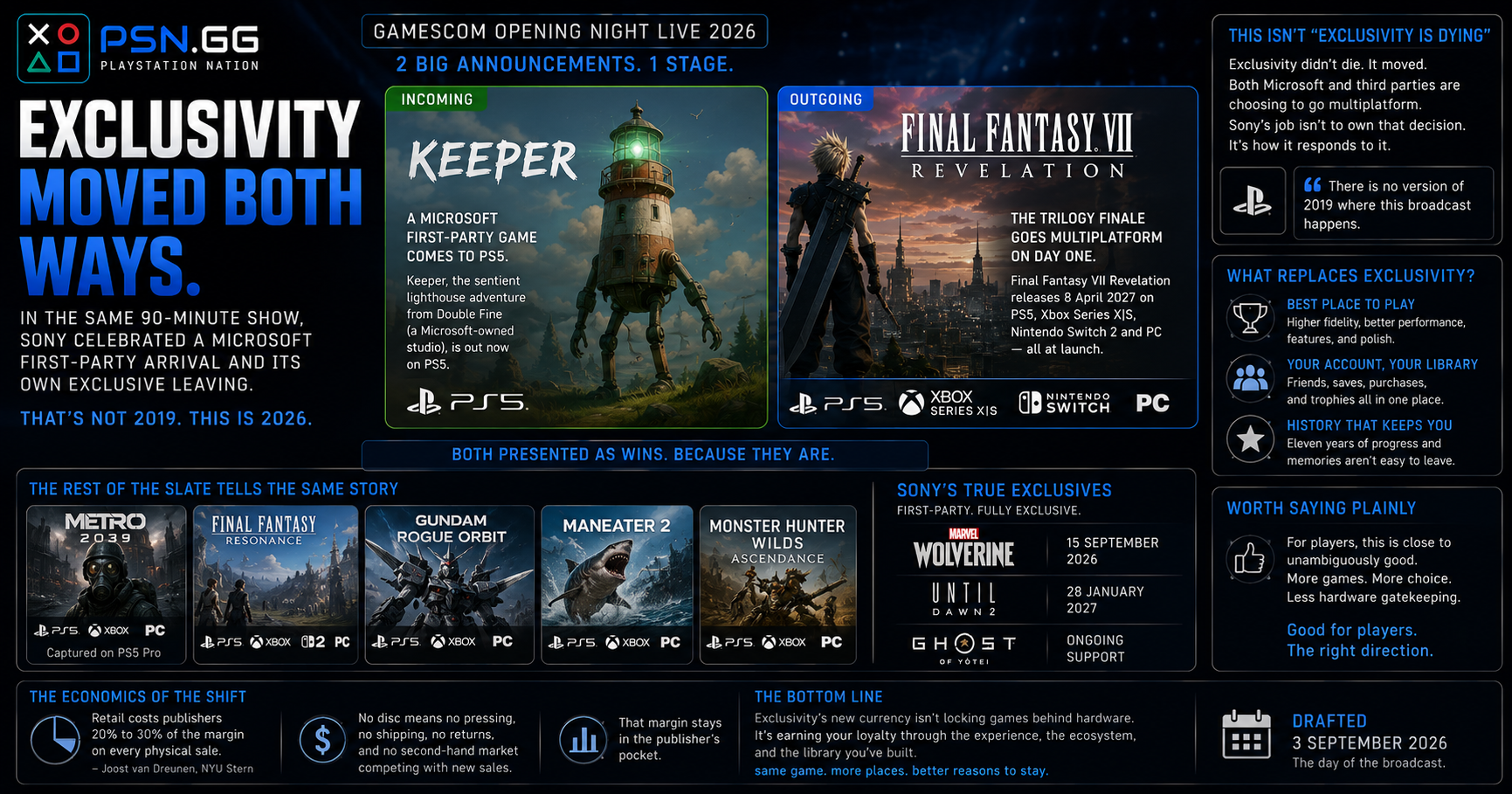
Keeper — the adventure game about a sentient, walking lighthouse, made by Double Fine, a Microsoft-owned studio — went live on PS5.
Final Fantasy VII Revelation — the finale of a trilogy Sony paid to keep exclusive twice — was confirmed for day-one release on Xbox Series, Switch 2 and PC alongside PS5.
Both on Sony's stage. Both presented as good news. Which, for the people watching, they are.
This is not "exclusivity is dying"
That framing has been around for years and it is too vague to be useful. What happened here is more specific and more interesting: exclusivity moved in both directions at once, in a single show, and the platform holder hosting it treated both movements as promotional wins.
A Microsoft first-party title arriving on PlayStation is a Microsoft decision. Square Enix going multiplatform is a Square Enix decision. Neither is Sony's to make. What is Sony's to make is how it presents them — and Sony presented an incoming Xbox game as a get and an outgoing Final Fantasy as its closing act.
There is no version of 2019 where that broadcast happens.
The rest of the slate says the same thing
Strip out the exclusives and look at what the show was actually made of:
- Metro 2039 — PS5, Xbox Series, PC. The trailer was captured on PS5 Pro, which is now the shape of platform marketing: not only here, but best here.
- Final Fantasy Resonance — PS5, Xbox Series, Switch 2, Switch, PC.
- Gundam Rogue Orbit — PS5, Xbox Series, PC.
- Maneater 2, Monster Hunter Wilds: Ascendance — multiplatform.
Against that, Sony's genuinely exclusive slate is short and entirely first-party: Marvel's Wolverine (15 September), Until Dawn 2 (28 January 2027), and continued Ghost of Yotei support.
What replaces exclusivity
If a game is on every box, a platform has to compete on something else. The Metro 2039 detail is the tell — the footage was captured on PS5 Pro, and the pitch was fidelity rather than availability.
That is the emerging argument for buying a console: not this is the only place you can play it, but this is the best place, and the place your library, saves, friends list and trophies already live. Lock-in through accumulation rather than scarcity.
It is a weaker hook on the shop floor and a much stronger one over a decade. Nobody switches platforms lightly when eleven years of trophy history is on the other side.
Worth saying plainly
For players this is close to unambiguously good. Fewer games are gated behind hardware you do not own. The finale of Final Fantasy VII will be playable by anyone who wants it, on the machine they already have, on 8 April 2027. Keeper is on PS5 for people who were never going to buy an Xbox for it.
The thing worth watching is not whether exclusivity survives. It is what platform holders reach for once it is gone — and on this evidence, the answer is the account, the library and the history attached to it.
Drafted 3 September 2026, the day of the broadcast.
Discussion
Sign in to comment with your PSN.GG identity.
Be the first member to comment on this story.