Every argument about physical games gets framed as sentiment against progress — collectors versus convenience. That framing suits the people making the decision, because it keeps the conversation away from the money.
So here is the money.
What a disc costs the people selling it
Joost van Dreunen, professor at NYU's Stern School of Business, speaking to AFP at Gamescom:
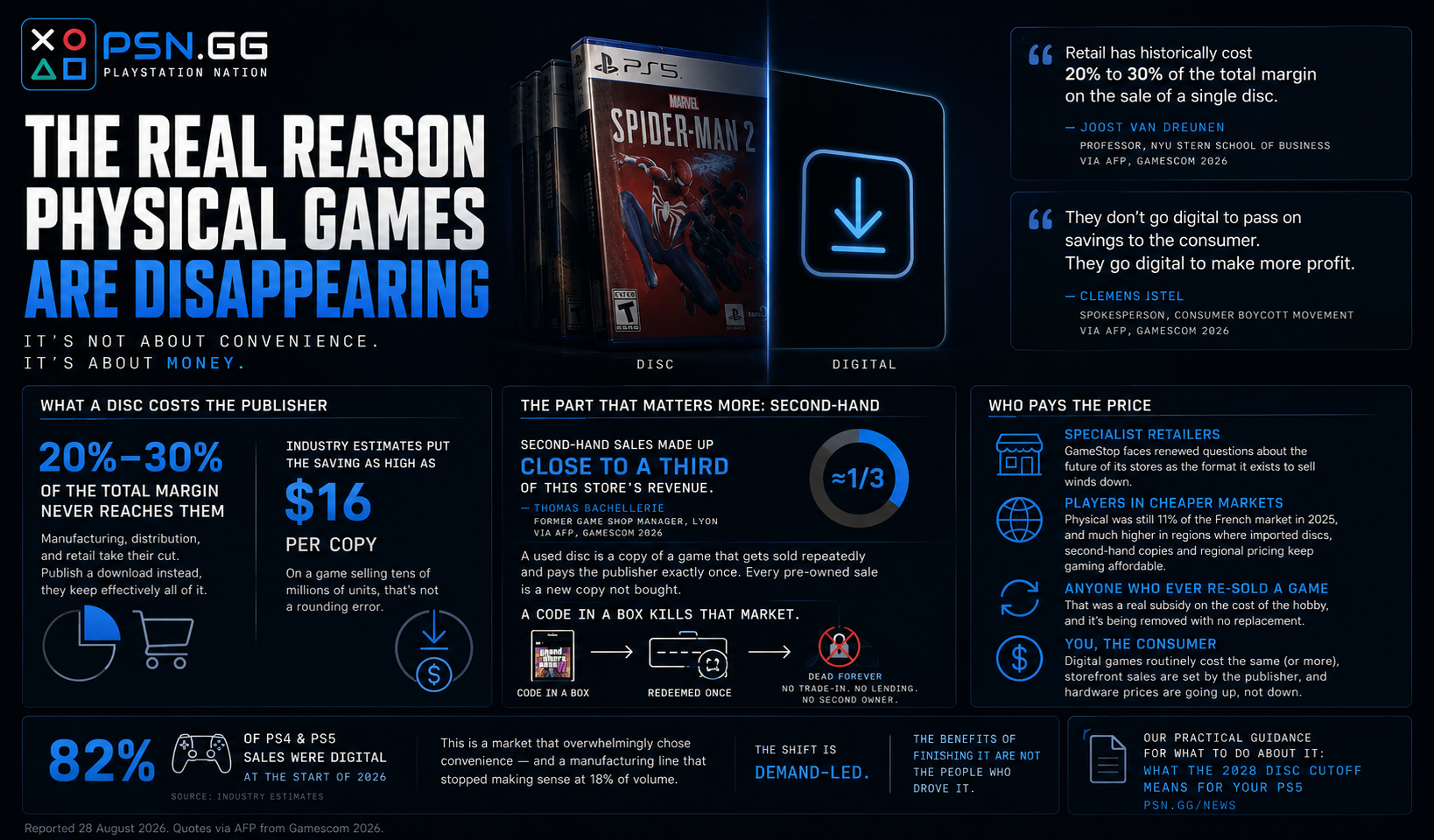
"Retail has historically cost 20% to 30% of the total margin on the sale of a single disc."
That is the share of the profit on a boxed game that never reaches the publisher — it goes to manufacturing, distribution, and the shop. Ship a download instead and the publisher keeps effectively all of it. Industry estimates put the saving as high as $16 per copy.
On a game selling tens of millions of units, that is not a rounding error. It is the single largest cost line a publisher can delete without changing the product at all.
The part that matters more: second-hand
Thomas Bachellerie, a former game shop manager in Lyon, gave AFP the number that explains the urgency. Second-hand sales made up close to a third of his store's revenue.
A used disc is a copy of a game that gets sold repeatedly and pays the publisher exactly once. Every pre-owned sale is a new copy not bought. Publishers have spent two decades trying to suppress that market — online passes, day-one DLC, account-locked content — and none of it worked, because a disc is a physical object and you cannot stop people selling their property.
You can, however, stop shipping the property.
That is what a code in a box achieves that no anti-used-games scheme ever managed. GTA 6's physical edition is single-use: redeemed once, dead forever. No trade-in, no lending, no second owner.
The disc did not lose to convenience. It lost because it was the last consumer-owned object in the transaction.
"They don't go digital to pass on savings"
Clemens Istel, speaking for the boycott movement, put the consumer side of it bluntly:
"They don't go digital to pass on savings to the consumer. They go digital to make more profit."
That is a claim rather than an accounting fact — but the evidence is not on the industry's side. Digital games routinely cost the same as boxed ones, and often more, since the shop that used to discount them is gone. Storefront sales are set by the publisher, not by a rival retailer down the road.
Meanwhile PlayStation hardware has gone the other way. The PS5 went through a price increase rather than the traditional mid-life cut — see the PS5 price increase explained — and the PS6 has no announced price at all because Sony says it cannot forecast memory costs.
If the savings from removing retail were reaching players, it would be visible somewhere by now.
Who pays
Specialist retailers. GameStop is already facing renewed questions about the future of its stores as the format it exists to sell winds down. A shop that loses new-release discs also loses the trade-ins that brought people through the door.
Players in cheaper markets. Physical was still 11% of the French market in 2025, and much higher in regions where imported discs, second-hand copies and regional pricing keep gaming affordable. Digital storefront pricing is far less flexible.
Anyone who ever resold a game. That was a real subsidy on the cost of the hobby, and it is being removed with no replacement.
The honest counter-argument
Digital was already 82% of PS4 and PS5 sales at the start of 2026. This is not a market being taken from players against its will — it is a market that overwhelmingly chose convenience, and a manufacturing line that stopped making sense at 18% of volume.
Both things are true. The shift is genuinely demand-led and the beneficiaries of finishing it are not the people who drove it. Publishers get the retail margin and the end of second-hand competition. Players get the same price and fewer rights.
Our practical guidance for what to do about it is in what the 2028 disc cutoff means for your PS5.
Reported 28 August 2026. Quotes via AFP from Gamescom 2026.
Discussion
Sign in to comment with your PSN.GG identity.
Be the first member to comment on this story.