When Sony announced this State of Play, it told everyone exactly how the show would end. The event would carry "updates and announcements from PlayStation Studios and our third-party partners," the company said, "concluding with an extended look at the vast world of Final Fantasy VII Revelation from our friends at Square Enix."
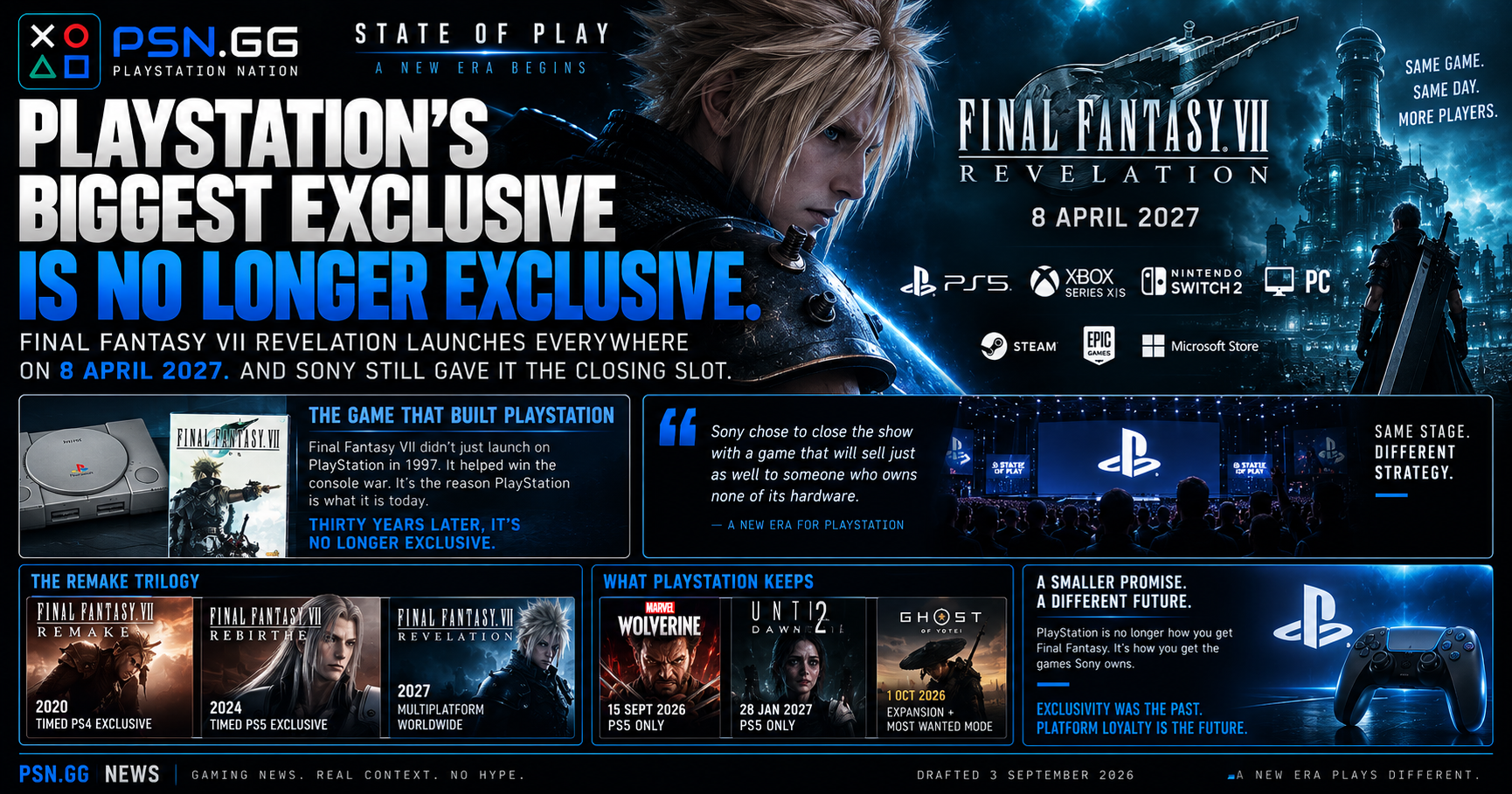
It did exactly that. Revelation closed the show, with a release date: 8 April 2027.
On PlayStation 5. And Xbox Series X|S. And Switch 2. And PC, across Steam, the Epic Games Store and the Microsoft Store. All on the same day.
Every outlet is writing this up as Final Fantasy VII Revelation gets a date. The date is not the story. The story is that Sony took the finale of the most consequential exclusivity relationship in its own corporate history, discovered it was no longer exclusive, and gave it the closing slot anyway.
Why this particular game
It is difficult to overstate what Final Fantasy VII means to this specific company.
The original was the game that decided the 1997 console war. Square's move from Nintendo cartridges to Sony's discs is the single most cited turning point in PlayStation's rise — the reason a CD-ROM machine from an audio company beat an entrenched incumbent. PlayStation did not merely have Final Fantasy VII. PlayStation is, in large part, a thing that happened because of Final Fantasy VII.
The Remake trilogy re-ran that relationship for a modern audience, and Sony paid to keep it:
- Final Fantasy VII Remake (2020) launched as a timed PS4 exclusive.
- Final Fantasy VII Rebirth (2024) launched as a timed PS5 exclusive.
- Final Fantasy VII Revelation (2027) launches everywhere at once.
Two thirds of a trilogy were sold as reasons to own a PlayStation. The third is not.
The part that is actually new
Square Enix drifting multiplatform is not news. The publisher has been visibly walking that direction for two years, and the commercial logic is not subtle: a trilogy finale needs the largest possible audience, and one platform's install base is not the largest possible audience.
What is new is Sony's posture toward it.
There was a version of this showcase where Revelation gets a polite ninety seconds in the middle of the runtime and the show closes on something Sony actually owns. Sony chose the opposite. It pre-announced Revelation as the finale, in its own words, in its own promotional copy, days ahead of the broadcast — and then built the back half of the show around a game that will sell just as well to someone who owns none of its hardware.
That is not a company that lost an exclusive. That is a company that has stopped organising its marketing around exclusivity at all.
What replaced it
Look at what Sony did keep for itself in this show, and the strategy becomes legible:
- Marvel's Wolverine — 15 September 2026, PS5 only, built for PS5 and explicitly not coming to PS4.
- Until Dawn 2 — 28 January 2027, PS5.
- Ghost of Yotei, still exclusive, getting the Echoes of Sekigahara expansion and the Most Wanted mode on 1 October.
Three first-party properties Sony owns outright. Meanwhile the third-party slate — Revelation, Metro 2039 (4 February 2027), Final Fantasy Resonance (22 October 2026), Gundam Rogue Orbit (5 March 2027) — is multiplatform essentially without exception.
The old arrangement was that Sony rented exclusivity from publishers it did not own. The new arrangement is that Sony owns what it wants exclusive and treats everything else as a storefront listing. Revelation closing the show is not a contradiction of that. It is the clearest statement of it Sony has made.
What it means if you only own a PS5
Practically: nothing bad. You get the game on 8 April 2027, in full, at the same moment as everyone else, with no waiting period.
Strategically: the reason to own this specific box has quietly narrowed to first-party output. Sony's own showcase just demonstrated that a PS5 is no longer how you get Final Fantasy — it is how you get Wolverine, Until Dawn and Ghost of Yotei.
That is a much smaller promise than the one PlayStation was built on. It may still be a good one. But it is worth noticing that the company retired the old promise itself, on its own stage, and used it as the finale.
Drafted 3 September 2026, the day of the broadcast.
Discussion
Sign in to comment with your PSN.GG identity.
Be the first member to comment on this story.