There is a protest running right now against Sony ending physical PlayStation games in January 2028. Thousands of people have switched their consoles off over it.
On 19 November 2026, fourteen months before that deadline, the biggest game of the generation arrives in a box with no disc in it.
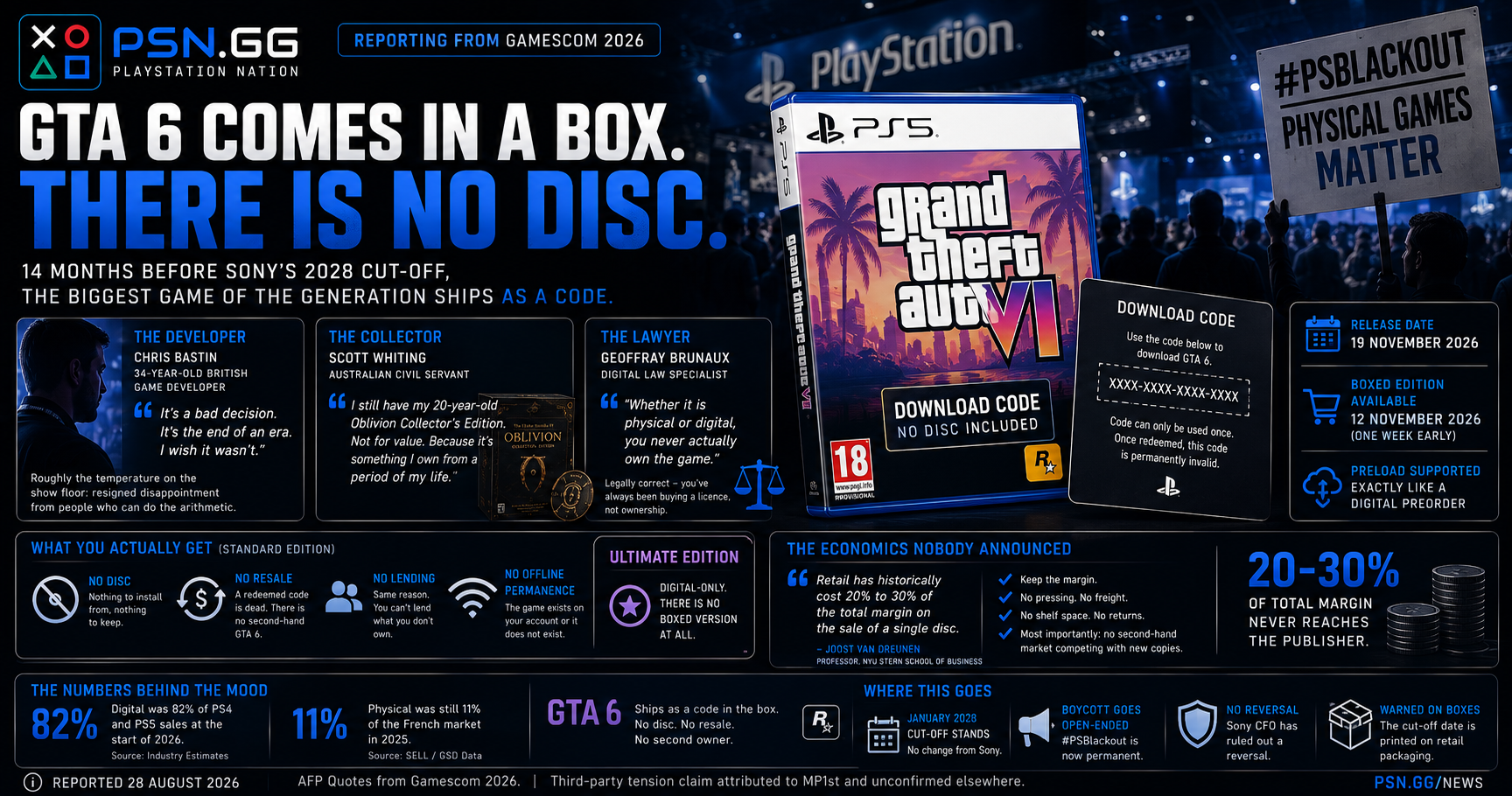
Grand Theft Auto VI's physical edition is a download code. Not a disc with a day-one patch. Not a partial install. A card in a box, single-use, and once it is redeemed to a PlayStation 5 or Xbox Series X|S account it is permanently invalid.
What you actually get
The box goes on sale 12 November, a week ahead of the 19 November launch, which lets you preload — exactly as a digital preorder does. Because it is a digital preorder, sold in cardboard.
That means, for the standard edition:
- No disc. Nothing to install from, nothing to keep.
- No resale. A redeemed code is dead. There is no second-hand GTA 6.
- No lending. Same reason.
- No offline permanence. The game exists on your account or it does not exist.
The Ultimate Edition does not even pretend — it is digital-only, with no boxed version at all.
Why this reframes the entire argument
The #PSBlackout protest is built on a date. Organisers moved from a one-week action to an indefinite one, asking participants to give up releases — GTA 6 among them — until Sony reverses a decision that takes effect in 2028.
But the change people are protesting is not waiting for 2028. It is arriving in November, from Rockstar and Take-Two, on a game Sony does not publish.
That is the part missing from almost all the coverage. Sony announced a manufacturing policy and absorbed the entire backlash. Publishers have been quietly reaching the same destination on their own schedule, without an announcement to be angry at, because "the box now contains a code" is not a press release — it is a packaging decision nobody has to defend.
Boycotting PlayStation over discs while the biggest disc-less release of the year comes from a third-party publisher is aiming at the most visible target rather than the most responsible one.
The economics nobody announced
There is a straightforward reason this is happening everywhere at once, and Joost van Dreunen, professor at NYU's Stern School of Business, put a number on it:
"Retail has historically cost 20% to 30% of the total margin on the sale of a single disc."
A publisher that ships a code instead of a disc keeps that margin. No pressing, no freight, no shelf space, no returns, and — critically — no second-hand market competing with its own new copies.
We break the full economics down in who actually profits from killing discs.
What this means if you were planning to buy it physically
Be clear-eyed about what you are buying. A boxed GTA 6 is a collectible container for a code. If you wanted it because physical means resale value, lending, or a copy that works regardless of account status, the box does not give you any of those.
If you want the box because you want the box, that is a completely legitimate reason — just buy it knowing what is inside.
And if you are taking part in the blackout specifically to protest the loss of physical media, GTA 6 is not the sacrifice it appears to be. There is no disc to abstain from.
The wider point
Sony's January 2028 date made the shift official, visible, and protestable. That has been useful — it forced the conversation. But treating that date as the moment physical dies gets the timeline wrong by more than a year, and points the anger at one company for an industry-wide decision.
Background on Sony's side of it is in our explainer on the 2028 cutoff, and the legal reality underneath all of it is in you never actually own the game.
Reported 28 August 2026. GTA 6 code-in-box confirmed by GameSpot, Kotaku and Push Square; release 19 November 2026, boxed edition available 12 November.
Discussion
Sign in to comment with your PSN.GG identity.
Be the first member to comment on this story.