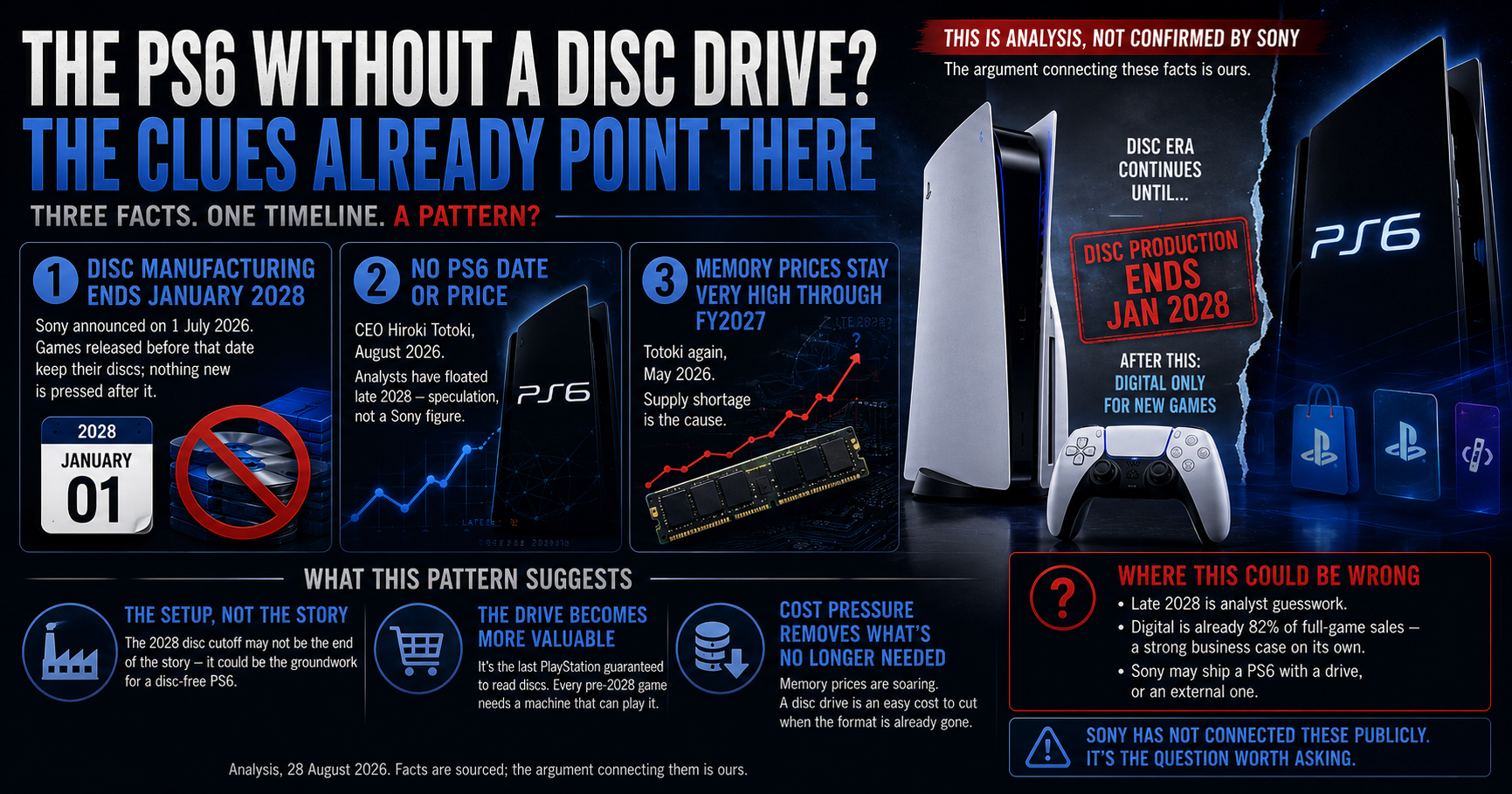
This article is analysis. It argues a case from three separately reported facts. Sony has not said any of what follows, and has not been asked it directly.
Here are the three facts.
- Disc manufacturing for new PlayStation games ends in January 2028. Sony announced it on 1 July 2026. Games released before that date keep their discs; nothing new is pressed after it.
- Sony has not set a PS6 launch date or price. CEO Hiroki Totoki, August 2026. Analysts have floated late 2028 — speculation, not a Sony figure.
- Memory prices are expected to stay very high through FY2027. Totoki again, in May, naming supply shortage as the cause.
Individually, each was reported as its own story. Together they describe something more coherent than three coincidences.
The date nobody asked about
When Sony announced the disc cutoff, the obvious follow-up went unasked and unanswered: does this apply to the next console? We flagged it as an open question in our explainer and it has stayed open.
But look at what a January 2028 cutoff actually does. It means that by the time a console plausibly arriving in late 2028 reaches shelves, the entire disc pipeline has already been wound down for the better part of a year. Retailer relationships, pressing contracts, packaging lines, distribution — all retired before the new hardware ships.
A next-generation console launching into that environment does not have to make a controversial decision about whether to include an optical drive. The decision was made a year earlier, quietly, as a manufacturing matter, and absorbed by the previous generation's audience.
That is a considerably easier announcement than "the PS6 has no disc drive".
Why the memory problem makes it sharper
An optical drive is not free. It is a mechanical component, a chunk of bill-of-materials cost, and a warranty liability, on a machine whose cost Sony has just told investors it cannot forecast because of RAM prices.
If you are staring at a console you cannot price, every removable cost gets examined. A drive that serves a format you stopped manufacturing eleven months earlier is the easiest line item in the building to cut — and by then, nobody can accuse you of removing it, because there would be nothing new to put in it.
The two stories are not merely adjacent. The first makes the second cheaper and less contentious.
What this would mean if it is right
The 2028 disc cutoff is not the end of the story, it is the setup. The protests treated it as the decision. On this reading it is the groundwork for the decision.
The PS5's disc drive becomes more valuable, not less. It is the last PlayStation hardware guaranteed to read the format. Every disc pressed before January 2028 needs a machine that can play it, and that machine is the one on sale now. Our practical guidance is in what the 2028 cutoff means for your PS5.
Sony's "cautiously move this forward" reads differently. CFO Lin Tao's line, covered in Sony rules out a reversal, sounded like stubbornness about a format decision. It sounds more like schedule discipline if the format decision is load-bearing for something else.
Where this could be wrong
Three honest caveats, because analysis without them is just a theory with confidence.
- Late 2028 is analyst guesswork. If the PS6 lands in 2029 or 2030, the tidy adjacency loosens considerably.
- The stated reason is plausible on its own. Digital is 82% of full-game sales by Sony's own most recent figure. That is a sufficient business case for ending disc production without any next-gen motive at all.
- Sony may well ship a PS6 with a drive, or an external one as the PS5 Digital already offers. Nothing here forecloses that.
What is not in doubt is the shape of the calendar. Discs stop in January 2028. The next console is unpriced and undated but broadly expected after that. Sony has not connected those publicly, and it has not been pushed to.
It is the question worth putting to them.
Analysis, 28 August 2026. Facts are sourced; the argument connecting them is ours.
Discussion
Sign in to comment with your PSN.GG identity.
Be the first member to comment on this story.