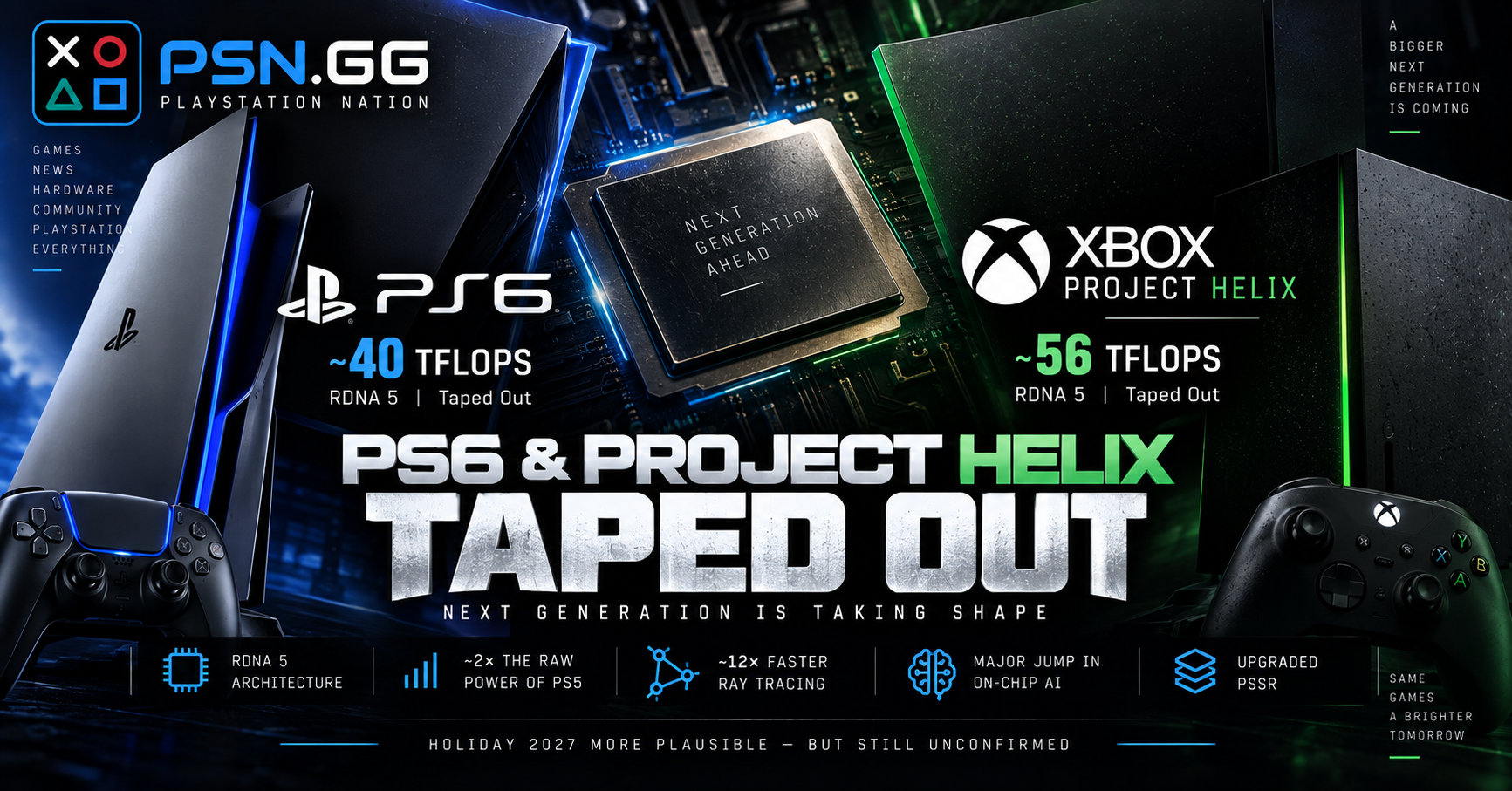
The hardware leaker KeplerL2, posting on the NeoGAF forums, says the PlayStation 6's main chip has been taped out — the design finalised and the layout files sent to the fabrication plant. The same claim covers Microsoft's next-generation chip, codenamed Project Helix.
We are going to handle this one differently from most rumour coverage, because it argues against something we published ourselves.
What is claimed
| PS6 | Xbox Project Helix | |
|---|---|---|
| Compute | ~40 TFLOPS | ~56 TFLOPS |
| Status | Taped out | Taped out |
Alongside those figures, the claim includes RDNA 5 architecture, roughly double the raw power of a base PS5, around 12× faster ray tracing, a large jump in on-chip AI throughput, and an upgraded version of the PSSR upscaler. Beebom's read of the two compute numbers puts Helix about 40% ahead on paper.
The tape-out itself is the only part that carries a schedule implication, and it is the part worth caring about. Sending final layout files to a fab is a real, expensive, hard-to-reverse commitment. In the normal course of chip development it happens a substantial stretch before retail units exist, because validation, yield work and mass production all sit between the two. Nobody involved has put a figure on that interval here, so neither will we — but a tape-out is not compatible with a console that is years from being scheduled.
Read that way, it points at a holiday 2027 window for both machines.
Why we are flagging this against our own reporting
On 28 August we published Sony still has no PS6 launch date — or price. In it we wrote that a 2027 launch "looks unlikely" and noted analysts had floated late 2028. That judgement rested on CEO Hiroki Totoki, who has said in two separate sets of remarks that neither the date nor the price is decided, and who pointed at memory pricing expected to stay elevated through FY2027.
We think that was the right call on the evidence available. It may also turn out to be wrong, and you deserve to hear that from us rather than discover it later.
Here is the honest state of play. The two accounts are not actually incompatible — they are answering different questions:
- A finished chip is not a finished console. Silicon can be locked while the launch date, the price and the manufacturing volume are all still open. That is precisely the position Totoki describes.
- Memory is the variable, not the processor. The bottleneck he named was RAM pricing, driven by AI data centres bidding for the same supply. Taping out a GPU does nothing to resolve that.
- "Undecided" is a statement about commitment, not capability. A company can be technically ready for holiday 2027 and still refuse to commit, because committing means fixing a price against a bill of materials it cannot forecast.
So the tape-out makes a 2027 launch possible in a way our earlier piece underweighted. It does not make it announced, and it does not answer the cost question that was our actual argument.
Treat the numbers with more suspicion than the tape-out
Three reasons to hold the TFLOPS figures loosely.
The provenance is a forum post. This is a well-known leaker with a following, but it is one person replying in a discussion thread — not a supply-chain document, not a partner briefing, and not corroborated by a second independent source. Neither Sony nor Microsoft has confirmed the tape-out or the specifications.
Teraflops predict less than they appear to. Mark Cerny has made this point himself, with the term "flopflation." The PS5 is roughly 20% behind the Xbox Series X on paper, and across the generation that gap has been close to invisible in how games actually run. A 40-versus-56 comparison between two unreleased machines with different architectures, memory subsystems and upscalers is not a ranking. It is two numbers.
The handheld is shakier than the rest. Push Square's coverage says a portable model is also planned. GamingBolt and Beebom both report the same NeoGAF posts and neither mentions one. We are not treating a PS6 handheld as part of this claim — if you saw that headline, this is why it is absent from ours.
What it changes for you
Nothing about a buying decision right now. Even on the most aggressive reading, holiday 2027 is over a year out, and Sony has not committed to it. If you were waiting on a PS6 before buying hardware, that wait is still long enough that it is not really a waiting strategy. Our guidance is unchanged in which PS5 should you buy and is the PS5 Pro worth it.
The price question is still the open one. It was the real story in August and it remains so. The PS5 has already taken a price increase rather than the usual mid-life cut — see the PS5 price increase explained — and a generation beginning under this kind of component pressure is not going to launch cheap.
Watch the 2028 problem. If the PS6 does arrive in holiday 2027, it lands weeks before Sony stops manufacturing physical PlayStation games in January 2028. We set that collision out in the 2028 collision, and a confirmed 2027 launch would make those two decisions land almost on top of each other.
The short version
One leaker, on a forum, says the PS6 silicon is done and heading to manufacturing at around 40 teraflops. That is a genuine milestone and it makes holiday 2027 more plausible than we allowed for in August. It is also unconfirmed, the compute figures are close to meaningless as a cross-platform comparison, and it leaves Sony's actual stated obstacle — what the memory will cost — exactly where it was.
Written 28 September 2026. Claims attributed to KeplerL2 via NeoGAF, as reported by Push Square, GamingBolt and Beebom on 3-24 September. Neither Sony nor Microsoft has confirmed any of it.
Discussion
Sign in to comment with your PSN.GG identity.
Be the first member to comment on this story.