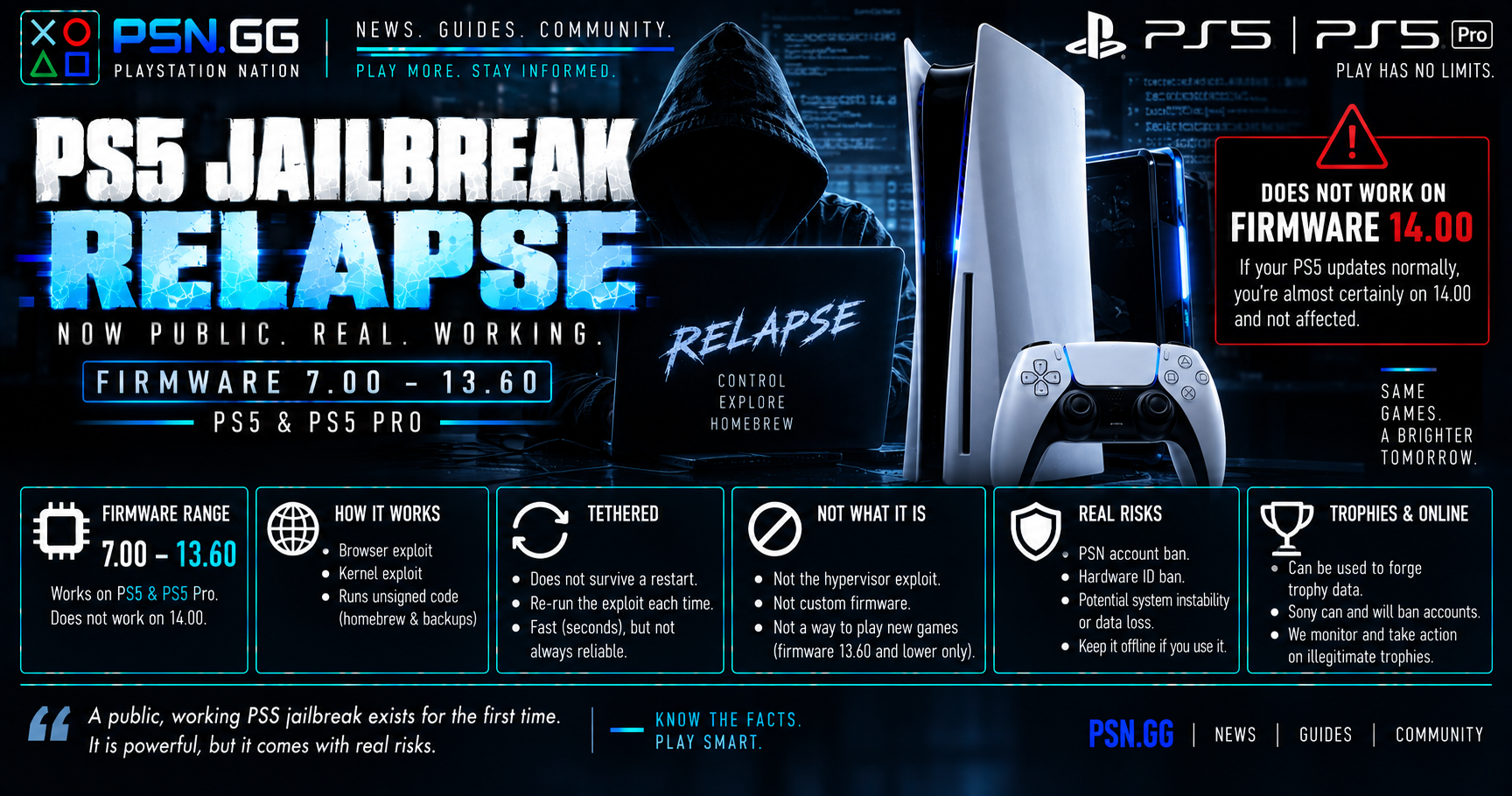
A PS5 jailbreak called Relapse went public on 29 September 2026. Unlike most of what the scene has produced over the last two years, this one is real, it is distributed, and people are running it.
It covers firmware 7.00 through 13.60, on both PS5 and PS5 Pro. It does not work on firmware 14.00.
That last sentence is the one that matters to almost everybody reading this.
If you installed the September update, this does not affect you
Firmware 14.00 — full build string 26.06-14.00.00 — went out on 16 September 2026. At the time it looked like a quality-of-life release: a PS5 Pro image setting switched on by default, a speaker indicator in voice chat, a Top 10 widget. We wrote it up on that basis in what the September PS5 update actually changed.
Thirteen days later it is the dividing line. Consoles on 14.00 are not vulnerable to Relapse. Consoles still on 13.60 or earlier are.
If your PS5 is online and has taken updates normally, you are almost certainly on 14.00 and there is nothing here for you to do.
What it actually is
The chain starts with a bug in the console's built-in web browser and escalates to a kernel exploit, giving read and write access to the system kernel. From there an ELF loader can run unsigned code — homebrew, and game backups.
Three properties define how useful it really is:
It is tethered. The jailbreak does not survive a restart. Reboot the console and you have a stock PS5 again until you re-run it. Nothing about it is permanent.
It is fast, which is genuinely new. Reports put it at seconds, against waits of up to 50 minutes for some earlier methods on firmware above 12.00. Speed is the reason this is spreading when previous exploits did not — a 50-minute ritual is a curiosity, a few seconds is a habit.
It is not reliable. The project itself warns that the browser stage may need several attempts and that the kernel stage can hang or crash the console. Its own description raises system failures, data loss and account bans.
What it is not
It is not the hypervisor exploit the scene has been sitting on. On 19 September we reported that scene figures claimed hypervisor-level work up to 13.60, deliberately held back until Sony patched it. This is not that release. Relapse operates at the kernel level, and no outlet reporting on it describes the hypervisor being defeated. The two are different privilege levels with different consequences, and conflating them is the main error circulating right now.
It is not custom firmware. Kernel read/write on a tethered exploit is a long way from a persistently modified console.
It is not a way to play new games. The firmware ceiling is the whole problem, which we come back to below.
Who made it
Decrypt names Nathan Fargo as the person who published Relapse, to GitHub under an MIT licence. A public demonstration by the MODDED WARFARE channel is what pushed it into general view, and several outlets have written that channel up as the developer. Those are two different contributions and it is worth keeping them straight.
We are not linking the repository, the demonstration, or the entry point the exploit uses. That is a standing policy here and this story does not change it.
The risk is your account and your console
Take this part seriously, because the coverage racing around social feeds mostly does not.
The exposure is both a permanent PlayStation Network account ban and a hardware ID ban. The second one is the part people underestimate: a console-level ban is not fixed by making a new account. The machine itself is what gets locked out of Sony's services.
A jailbroken console kept entirely offline is one conversation. A console that signs in, syncs trophies, or touches any account-linked service is a different one, and it is the one where Sony has both the visibility and the stated grounds to act. Sony's terms do not permit modified consoles. That has not changed and there is no reading of this week's news in which it has.
What this means for trophies and leaderboards
This is the part that matters most on a site built around trophy tracking, so we will be direct about it.
Kernel-level access on a console that can still reach PSN is the foundation of forged trophy data — unlocks that never happened, timestamps that make no sense, platinums on games the account barely launched. A faster, easier exploit means more of it, not less.
What that does not mean is that the leaderboards are about to fill up with fakes. We already treat trophy data as something to be verified rather than trusted, and what happens to a jailbroken PS5 on our leaderboards sets out how we handle profiles that show signs of it. We do not publish the specifics of how that works, for reasons that should be obvious on a day like this.
If you legitimately earned your trophies, nothing about Relapse threatens your standing. If you are considering the other route, the honest summary is that the account risk from Sony arrives long before anything we do.
The trap nobody mentions on day one
Relapse tops out at firmware 13.60. Games released from here on will increasingly require newer system software than that.
GTA 6 arrives on 19 November. A console frozen below 14.00 to preserve this exploit is a console that will very likely not run it — and the same logic applies to most major releases over the next year. You are choosing between homebrew on old firmware and the games actually coming out.
We are not going to tell you to hold firmware back, and we would not have told you that before Relapse existed either. Staying behind means giving up system updates, current games and online services, and betting your hardware on a tethered exploit that Sony will close.
The timing is almost too neat
Decrypt makes a point worth repeating. This lands immediately after Sony argued that buyers should not reasonably believe they own the digital games they have paid for — an argument we covered in Sony's own email saying digital games are licensed, not sold and in you never actually own the game.
There is a real tension there, and it is worth stating plainly rather than pretending it resolves neatly. A company telling customers they do not own their software, in the same month a tool appears letting those customers take control of the hardware they unambiguously do own, is a genuine argument about consumer rights — and it is also, in practice, the thing most people will use to run games they did not buy. Both of those are true. Neither cancels the other, and the ban policy applies regardless of which one motivates you.
The short version
A public, working PS5 jailbreak exists for the first time. It is tethered, unreliable, capped at firmware 13.60, and carries account and hardware bans. Firmware 14.00, released 16 September, is not affected — so if your console updates normally, this is a story you can read rather than a decision you have to make.
Written 29 September 2026. Firmware ranges confirmed across Kotaku, Decrypt, tbreak, HotHardware and Insider Gaming. We report on console security research; we do not publish exploit methods, tools or links.
Discussion
Sign in to comment with your PSN.GG identity.
Be the first member to comment on this story.